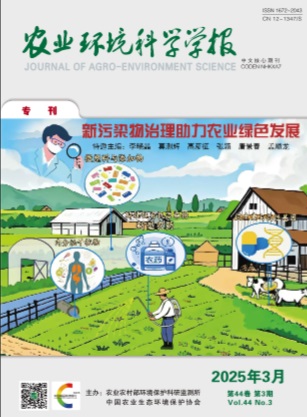
| 许剑锋,孟庆婷,傅佳杰,金羽清,蔡建军,马嘉伟,王美.沼液施用下的西蓝花种植土壤微生物群落演变特征[J].农业环境科学学报,2025,44(12):3172-3180. |
| 沼液施用下的西蓝花种植土壤微生物群落演变特征 |
| Evolution characteristics of soil microbial communities in broccoli cultivation under biogas slurry application |
| 投稿时间:2024-12-04 |
| DOI:10.11654/jaes.2024-1061 |
| 中文关键词: 沼液 西蓝花 土壤细菌群落 土壤真菌群落 |
| 英文关键词: biogas slurry broccoli soil bacterial community soil fungal community |
| 基金项目:国家重点研发计划项目(2023YFD1902900) |
|
| 摘要点击次数: 1319 |
| 全文下载次数: 684 |
| 中文摘要: |
| 为探讨沼液施用对西蓝花种植土壤细菌和真菌多样性的影响,通过宏基因组测序技术,对比分析化肥与沼液配施(MIX)以及全量施沼液(BS)处理下西蓝花土壤中细菌与真菌的多样性变化,并结合土壤的理化性质,揭示微生物群落的演变规律。结果显示:与对照(CK)相比,BS处理显著提高了土壤 pH值和土壤有机质、速效钾和有效磷含量,其中速效钾和有效磷含量分别增加了633.0%和95.3%;MIX处理降低了土壤pH值,但提升了全氮和有效磷含量。微生物群落分析表明,与CK相比,在细菌方面,BS处理增加了土壤中假单胞菌门和绿弯菌门的丰度,后者的丰度提升高达229.6%;MIX处理则显著提高了土壤中拟杆菌门的丰度。在真菌方面,BS处理显著促进了土壤中子囊菌门的增殖,其丰度提高了 148.7%,而 MIX处理则提升了土壤中油壶菌门的丰度。相关性分析表明,鞘氨醇单胞菌属的丰度与有机质和速效钾呈正相关;曲霉属的丰度随pH值的提升而增加,但与碱解氮和全磷呈负相关。研究表明,沼液的施用显著提高了土壤pH值和有机质、速效钾、有效磷含量,优化了微生物群落结构,增强了细菌和真菌群落的养分循环与病害抑制能力。沼液作为绿色有机肥料,具有提升农田土壤质量和促进可持续农业发展的潜力。 |
| 英文摘要: |
| To investigate the impact of biogas slurry application on the diversity of bacterial and fungal communities in soils used for broccoli cultivation. Using metagenomic sequencing technology, we analyzed the changes in bacterial and fungal diversity under two treatments:combined application of chemical fertilizer and biogas slurry(MIX), and sole application of biogas slurry(BS). Combined with soil physicochemical properties, we further revealed the evolutionary patterns of microbial communities.The result shows that:Compared with the control(CK), the BS treatment significantly increased soil pH, soil organic matter(SOM), available potassium(AK), and available phosphorus(AP), with AK and AP content increasing by 633.0% and 95.3%, respectively. In contrast, the MIX treatment reduced soil pH but enhanced total nitrogen(TN)and AP levels. Microbial community analysis revealed that, in terms of bacteria, the BS treatment markedly increased the relative abundances of Pseudomonadota and Chloroflexota, with Chloroflexota showing a notable increase of 229.6% compared to CK. The MIX treatment, on the other hand, significantly enriched Bacteroidota. For fungi, the BS treatment significantly promoted the proliferation of Ascomycota, with a 148.7% increase in abundance, while the MIX treatment enriched Olpidiomycota populations in the soil. Correlation analysis indicated that the abundance of Sphingomonas was positively correlated with SOM and AK, while the abundance of Aspergillus increased with higher pH but was negatively correlated with alkaline hydrolysis nitrogen (AHN)and total phosphorus(TP). In conclusion, the application of biogas slurry significantly improved soil pH, SOM, AK, and AP levels, while simultaneously optimizing the soil microbial community structure. These changes enhanced nutrient cycling and disease suppression potential in bacterial and fungal communities. As an environmentally friendly organic fertilizer, biogas slurry holds great promise for improving soil quality and promoting sustainable agricultural development. |
| HTML
查看全文
查看/发表评论 下载PDF阅读器 |
|
|
|