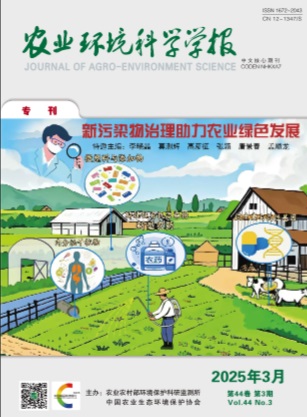
| 林雷利,后明军,汪小宇,陈杨,李笑笑,宋贺,吴巩.增温与秸秆还田深度对小麦光合特性和产量的影响[J].农业环境科学学报,2026,45(5):1092-1104. |
| 增温与秸秆还田深度对小麦光合特性和产量的影响 |
| Effects of warming and straw return depth on photosynthetic characteristics and wheat yield |
| 投稿时间:2025-06-10 |
| DOI:10.11654/jaes.2025-0538 |
| 中文关键词: 增温 秸秆还田深度 小麦 光合特性 产量 |
| 英文关键词: warming straw return depth wheat photosynthetic characteristics yield |
| 基金项目:国家重点研发计划青年科学家项目(2023YFD2302400);国家自然科学基金青年项目(32301959);安徽省自然科学基金青年项目(2308085QC88) |
|
| 摘要点击次数: 23 |
| 全文下载次数: 4 |
| 中文摘要: |
| 为明确气候变暖和不同秸秆还田深度对小麦生长发育和产量的影响,通过红外辐射设备模拟大田增温,设置两个温度水平(T0:环境温度;T1:增温)和不同秸秆还田深度(SR:秸秆不还田;SM:秸秆覆盖还田;S20:秸秆0~20 cm还田;S40:秸秆20~40 cm还田),探究增温和秸秆还田深度对小麦光合特性、叶片酶活性和产量的交互影响。结果表明:相较于环境温度,增温使小麦花前生育期缩短6 d,花后生育期缩短1 d,造成全生育期缩短7 d;增温降低了小麦灌浆期叶片谷氨酰胺合成酶、硝酸还原酶、谷草转氨酶和谷丙转氨酶等氮代谢酶活性和超氧化物歧化酶、过氧化物酶、过氧化氢酶等抗氧化酶活性,同时降低了叶面积和净光合速率,造成花后代谢产物游离氨基酸和可溶性糖含量显著下降29.8%和30.9%;相较于秸秆不还田,秸秆覆盖还田与秸秆0~20 cm还田提高灌浆期旗叶氮代谢酶活性(21.4%~44.0%)与抗氧化酶活性(14.1%~63.0%),延缓叶片衰老,维持花后净光合速率,提高游离氨基酸含量(19.2%~22.7%)与可溶性糖含量(7.9%~20.7%),促进小麦灌浆进程。同时,增温和秸秆还田深度对谷氨酰胺合成酶和过氧化氢酶活性存在显著的交互作用。产量结果表明,增温降低穗粒数与千粒质量,造成产量显著下降5.1%;而秸秆覆盖还田条件下,有效穗数、穗粒数和千粒质量增加导致增产13.6%。相关性分析进一步表明,小麦产量和净光合速率与氮代谢酶、抗氧化酶活性呈现显著正相关关系。研究表明,增温缩短小麦生育期,降低花后小麦光合能力和叶片酶活性,抑制物质的合成与积累,最终造成小麦产量下降;而秸秆覆盖还田与秸秆0~20 cm还田通过调节花后叶片氮代谢与抗氧化能力,维持光合特性,延缓叶片衰老,弥补增温对小麦产量的不利影响。 |
| 英文摘要: |
| To investigate the effects of climate warming and straw return depth on wheat growth and crop yields, two temperature levels(T0: ambient temperature; T1: elevated temperature)were established using infrared radiation equipment to simulate field warming, along with four straw return depth(SR: straw removal; SM: straw mulching; S20: straw 0-20 cm returned; S40: straw 20-40 cm returned). This experimental design aimed to examine the interactive effects of warming and straw return depth on photosynthetic characteristics, leaf enzyme activities and wheat yield. Compared to ambient temperature, warming shortened the pre-anthesis period by 6 days and the post-anthesis period by 1 day, finally reducing the entire growth period by 7 days. During filling stage, warming suppressed enzyme activities related to nitrogen metabolism(glutamine synthetase, nitrate reductase, glutamine oxaloacetic transaminase, glutamine pyruvic transaminase)and antioxidant defense(superoxide dismutase, peroxidase, catalase), while reducing leaf area and net photosynthetic rate. This resulted in the reductions of free amino acids content(29.8%)and soluble sugar content(30.9%). Compared to straw removal, straw mulching and 0-20 cm straw returned enhanced flag leaf nitrogen metabolism enzyme activities(21.4%-44.0%)and antioxidant enzyme activities(14.1%-63.0%), which delaying leaf senescence and maintaining post-anthesis net photosynthetic rate. Consequently, straw mulching and 0-20 cm straw returned increased free amino acids(19.2%-22.7%)and soluble sugars(7.9%-20.7%), ultimately promoting wheat grain filling. Meanwhile, there were significant interactions of warming and straw return depth on glutamine synthetase and catalase activities. Yield analysis revealed that warming reduced grain number per spike and 1 000-grain weight, resulting in a significant yield reduction of 5.1%. In contrast, straw mulching increased panicles number, grain number per spike and 1 000-grain weight, consequently enhancing wheat yield by 13.6%. Correlation analysis indicated significant positive relationships of wheat yield and net photosynthetic rate with nitrogen metabolizing enzymes and antioxidant enzymes. In conclusion, warming shorten wheat growth period, reduced post-anthesis photosynthetic capacity and leaf enzyme activities, inhibited the synthesis and accumulation of photosynthetic products, consequently reducing crop yields. While straw mulching and 0-20 cm straw returned regulated nitrogen metabolism and antioxidant capacity of post-anthesis, maintained photosynthetic characteristics, and delayed leaf senescence, finally mitigating the adverse effects of warming on wheat yield. |
| HTML
查看全文
查看/发表评论 下载PDF阅读器 |
|
|
|